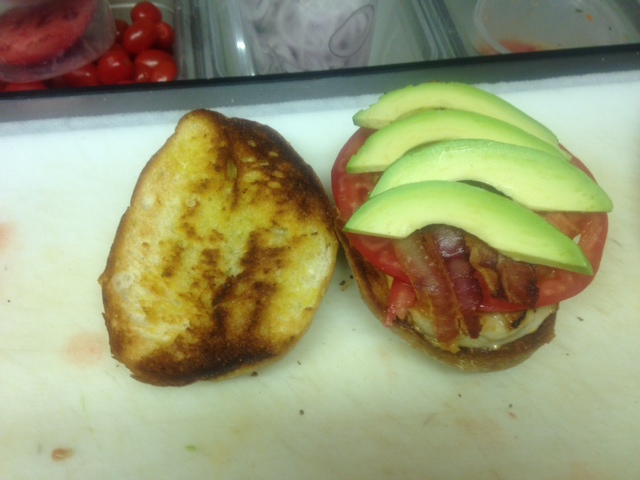
Just look at that luscious avocado!
All it needs is a topper of lettuce and a slice down the middle and it’s done, another scrumptious Chicken BLAT!

Just look at that luscious avocado!
All it needs is a topper of lettuce and a slice down the middle and it’s done, another scrumptious Chicken BLAT!

Why do Spaniards cook meat with raisins and capers? So today we clue you in to a well kept secret about Latin cooking— Morocco!
Spain is just across the Strait of Gibraltar from Morocco, and used to have title to territory there. Carmen’s former mother-in-law was Moroccan Spanish, and taught her a lot of recipes. They often combine sweet and savory in meat dishes, so our Picadillo (popular in Cuba as well as Spain) contains ground beef with onions, raisins, olives and capers.
If you love the combo (like I do, I sometimes have it three meals a day) wait till winter and taste the Carne Guisada, Moroccan beef stew. It’s cooked with prunes or apricots plus the savories, and wow, is it out of this world!

About the only way you hear these guys is to hire them for your party (hey, we don’t mind!) or come to Carmen’s when they play. Shows @ 6 & 8, $5 cover each
now for tonight’s news from the happeningest bistro on First and Adams:
Tilapia over saffron rice w/ garlic-wine sauce
Cubano Sandwich by popular demand— pork, ham & swiss w/ mustard & pickle on Cuban bread
Picadillo
Pernil Pork, slow roasted for 14 hours…served with arroz con gandules…that’s herbed rice with pigeon peas
Desserts tasty & traditional
Flan
Key Lime Pie
Triple Chocolate Cake
Sensemaya– 9/19
Mundo Nuevo– 10/24
Elizabeth Kasius & Heard– November TBD
The Nellies– Victorian Stroll
Mundo Nuevo– 12/19
by Metroland Staff on July 24, 2014 ·
But you already knew we made the best Cuban food!
In addition to the six— yes, count ’em, six— 2014 Metroland Reader’s Poll wins, Carmen just snatched the prize for Best Cuban.
We know there was never a Best Cuban before but they created the category just for us. We’ll call that a win!
And that was before we had all these garden fresh tomatoes on hand–Imagine what we’ll be doing with them all week!

Best Cuban: Carmen’s Cafe
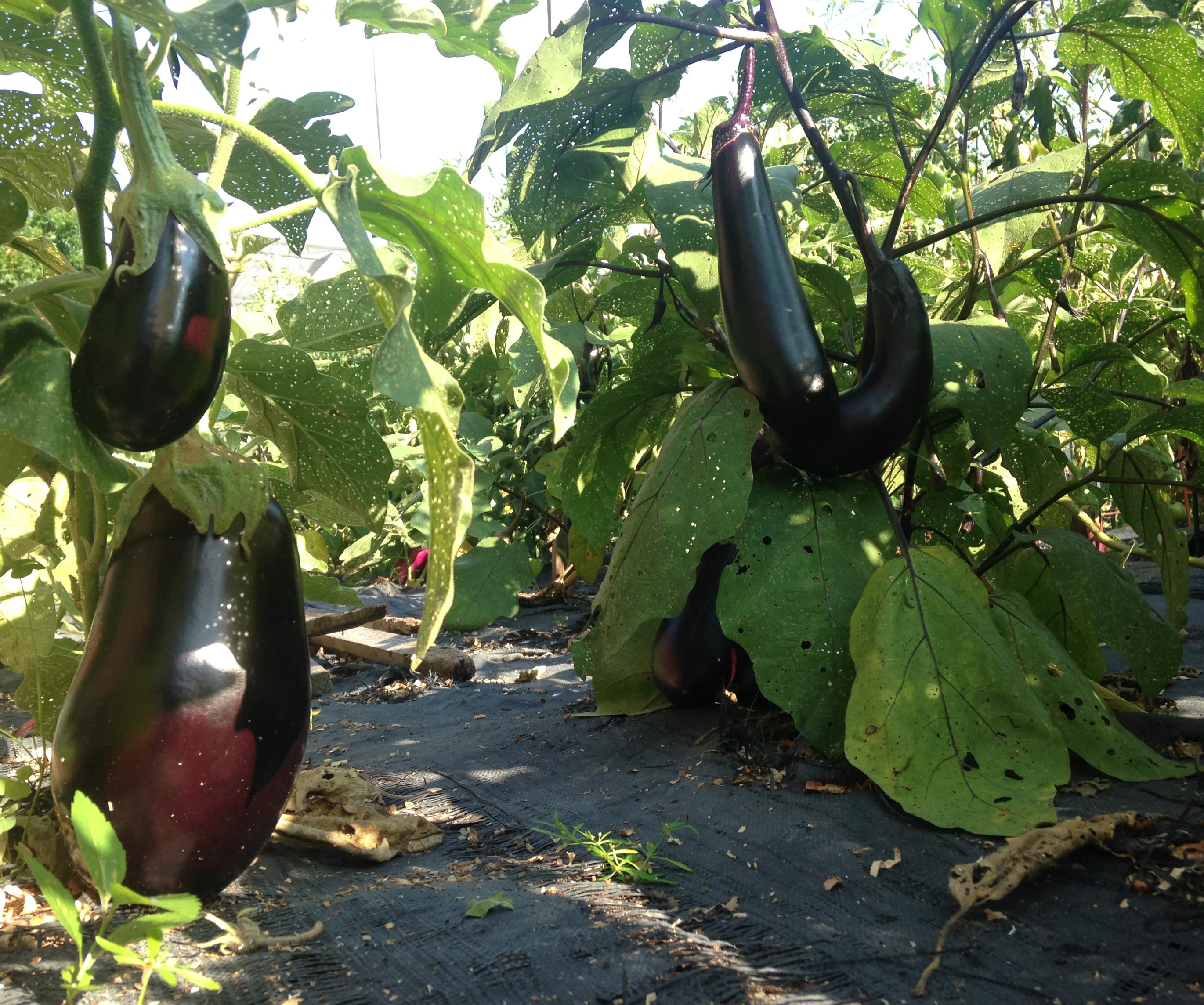 It may be kinky, but we love it when you talk dark stuff—Eggplant, why do we love thee? Is it for thy phytonutrients? Thy low calories, or thy trace nutrients?
Aubergines are in the nightshade family, as are bell peppers, tomatoes and potatoes, and is technically a berry. It is a main ingredient of babaganoush, moussaka, and ratatouille.
It contains phenolic antioxidants and has been shown to have anti-mutageic, antioxidant, and anticholesterol properties. Lab rats have had their LDL cholesterol seriously lowered and their arteries buffed and polished, with repairs to arterial walls and the works, just by eating eggplants.
 July and August is Reading Month at the Troy Library. Jim Lewis is one of many readers, but he’ll be the only one on Thursday, August 14th at 6:30.
He will, however, be accompanied by Ray Andrews on Baroque Guitar.
Not that we are biased, but both are worth a good listen.
Since she was a young girl, Francelise has collected fabrics. As an artist, she snips and sews collages— sometimes figural, sometimes abstract. Meet her this Thursday, Aug. 7, from 5-8 pm and discuss her work over Tapas and Sangria.
Yes, we’ve done it again, Carmen’s has scored another amazing artist and is showing some of her best and prettiest work. It’s the perfect time to take some home with you— at Carmen’s we don’t charge the artist a commission, so all proceeds go directly to Francelise.
First Time! Besides serving Tapas Samples, we’ll be serving Tapas Dinners! Limited selection, but if someone should, say, ask for an authentic Cubano Sandwich we’d be happy to oblige!
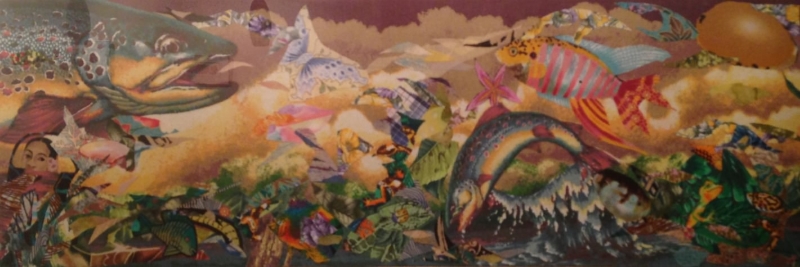
Collages, whether made of words, paper, objects or cloth, have always been my means of expression. In 1988, I first coined the term “Silkollages” to introduce my meditative concept in textile collages to interior designs. Then in 1992, I added “Ethnikollages” to re-activate cultural interests. My collages are either embroidered into miniature quilts, or framed into window boxes. When large and three-dimensional, they become hanging art quilts or soft installation pieces. Abstract or representational life forms as dancing shapes seem to multiply in my work. I draw them out of colorful cloth from Asia, Africa and Europe to visually create a blurring of boundaries between such cultures. As a collage maze is formed, the viewers are invited to enter it. If my playing on fabric brings the viewers to rethink the multiplicity expressed, an expansion of their own true awareness might occur. What I seek is an element of uncensored, emotional surprise, beyond multicultural reality. I am on a spiritual exploration, deepening my sense of what it really means to belong to the human race. It is about exploring that sense of oneness, born out of welcoming the difference we are.
Francelise Dawkins is a Parisian “textile collagist”, living in the U.S. for over two decades. She first studied Fiber Arts at the Art League School of Indianapolis before moving to NY, where she developed her meditative concept for interior designs in textile collages. She has since exhibited or taught at the American Craft Museum in NYC, the Smithsonian Institute in Washington DC, the New Orleans Museum of Art, the NY State Museum in Albany, NY, and other renowned venues. One of her installations was part of the “Putt-Modernism” show at the Hyde Collection Museum in Glens Falls, NY. Writing about her art, she had essays published, such as the one on intuition in Margaret Blanchard’s book: “From the Listening Place”. She designed the art cover for Gisele Pineau’s French novel: “L’Espérance-Macadam”. Many of her pieces have been shown in magazines, on cable network TV and books, such as Carolyn Mazloomi’s contemporary art quilt book: “Spirit of the Cloth”. Her work is part of the permanent collection of the Museum of the American Quilter’s Society in Paducah, KY.

Mofungo patties (mashed green plantains, mixed w/ peas & chopped red pepper) topped w/ poached eggs & pea purée.
Wowing Zowie! Top it off with a Cortado and you are really cooking!
Cuban Coffee, called Cortado, is a specific way to make what might otherwise be called a Latte. You start with Cuban roast espresso beans— not burnt, like a French roast, but dark, rich, flavorful. Steam the milk just so— not as much big foam as in a Latte, but thickened with microfoam so it adds a dense, caramelly texture. Properly done, the sweetness comes from the milk, and contrasts pleasantly with the bitterness of the coffee.
You may like it with a small spoon of sugar, put real Cubanistas take it straight.

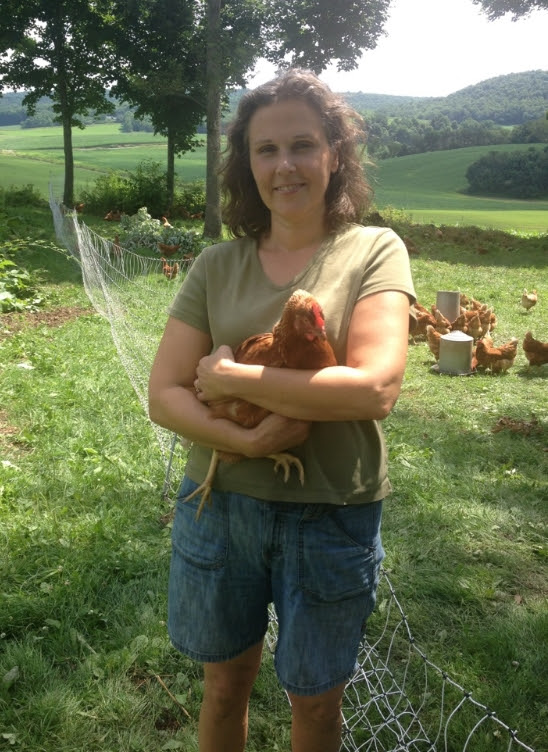 Hardworking hens from Davis Family Farms
Astrid (the owner) works hard too!
We get a lot of eggs from the Davis Farm. You may have noticed– the creamier taste, the proud, round yolks, the fluffy texture.
Mavis (the hen) enjoys life on the farm. She eats organic food, and every week her coop is moved, letting her scratch a new feedlot. There’s a friendly labrador to keep her company and scare away the foxes. It doesn’t get any better than this!
Oops, yes it does— have breakfast at Carmen’s with fresh (hours fresh, not weeks old) hen scratch eggs!
 Carmen's Bistro